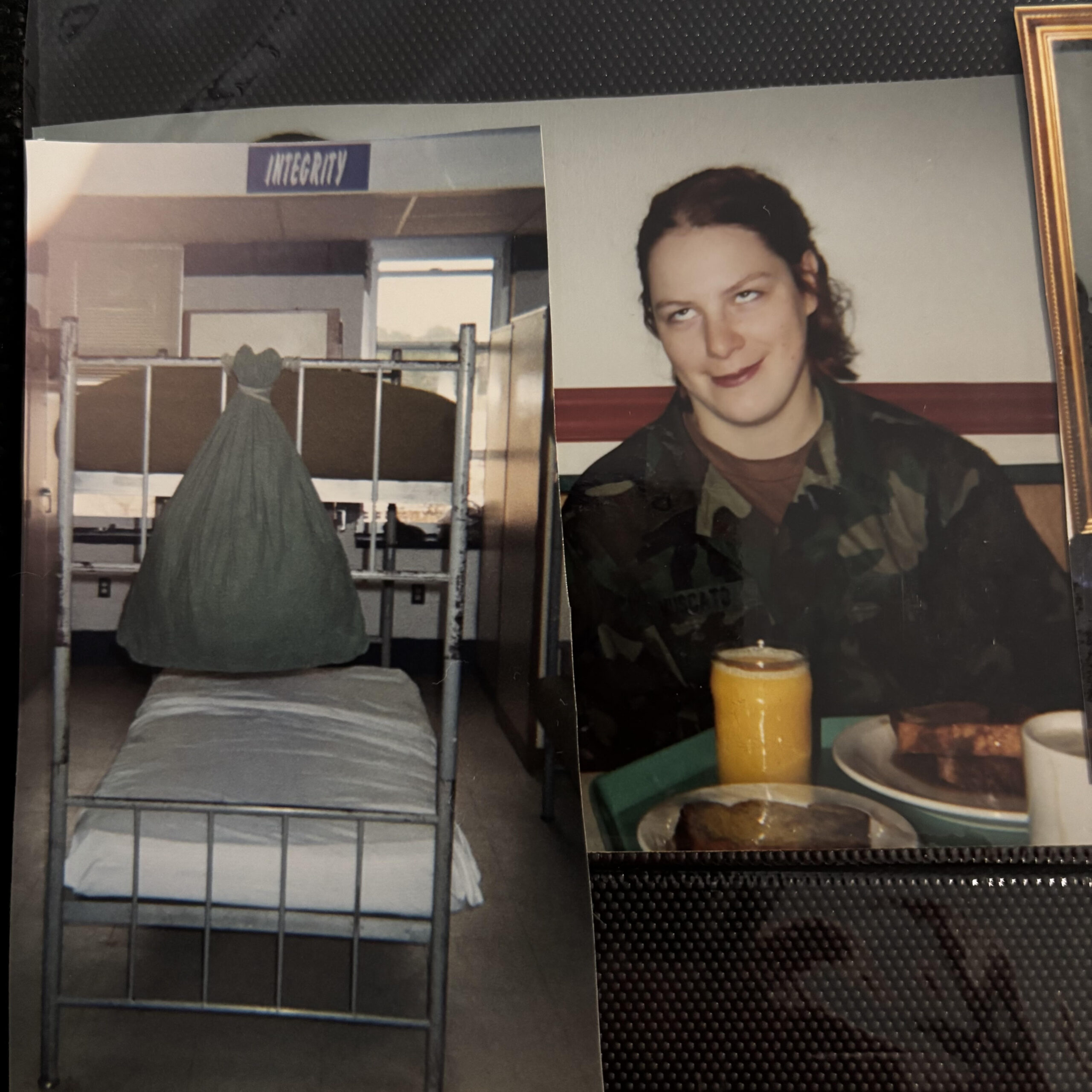
It is what it is.
I met Chris at an art show in Baltimore in November 1999. A few days later, he took me on a date to an indoor firing range.
I was a newly minted 21-year-old seeking a college education, life experience and a way to control my emotions.
Chris was almost eight years my senior and had recently returned to Maryland after serving a handful of years in the Army. His divorce was finalized early in our relationship, and then he moved into my townhouse.
We married in July 2000, after Chris decided to return to the military for a three-year contract in Germany.
After our courthouse wedding, Chris and I moved to South Carolina, where he worked at Fort Jackson as his security clearance processed.
I wanted to travel but not as a military wife.
I decided to join the U.S. Army Reserves while working as a waitress at a steakhouse.
The signs got me thinking.
Once I drove through the security checkpoint at the entrance to the military base, a line of thin, brown signs said one after the other:
Loyalty
Duty
Respect,
Selfless Service
Honor
Integrity
Personal Courage
LDRSHIP: The symbol piqued my curiosity. Could I make it?
I enlisted and started basic combat training in November 2000.
The yelling started like the first chord of a metal concert setting off a mosh pit as soon we arrived.
“GET OFF MY BUS” the drill sergeants demanded as soon as we parked.
I gathered my bags as authority figures faded into the background.
A soldier-in-training who was waiting on a medical discharge helped us new arrivals to basic training find dinner and bed sheets that first night.
One soldier made us all laugh when she said her bedroll didn’t have a “fitted sheet.” From then on, we called her “Private Benjamin,” teasing a reference to the 1980 movie starring Goldie Hawn.
Our barracks were on the third floor, an open room framed by bunk beds dressed in stiff green blankets.
Everything I owned for those eight weeks of training fit into a roughly 5-foot tall, brown footlocker.
Blue lines painted on the floor formed a box around the center of the room on which soldiers in training stood every day at 0500 hours and sang the “National Anthem.”
I appreciated the structure because I knew when we would eat next.
On my third day, “a male died.”
That’s what I wrote in my journal about a man who passed out in the chow line.
I heard he was an 18-year-old soldier who either choked or maybe had a heart attack, but my writing in the moment disagrees with my memory, in which I see a man choking and making a scene on the opposite side of a large cafeteria.
Basic training tested my fear of asphyxiation.
During one training exercise, drill sergeants boomed, “You CAN breathe; you’re breathing,” after we removed our masks in a cabin filled with tear gas.
How did I get through it?
I accepted that I asked for this.
I later learned that Marsha Linehan, who developed the therapy for people with borderline personality disorder, called the idea “radical acceptance.”
I sang Tori Amos to myself:
You raised your hand for the assignment / tuck those ribbons under your helmet; be a good soldier / first my left foot, then my right behind the other
Chris gave me his broken-in jump boots, which helped tremendously when my newly issued boots blistered my heels during marches.
I sang “the ants go marching one by one hurrah, hurrah” in my head.
I mumbled the melody as I moved in stiff boots one day, on the verge of crying, while carrying my eight-pound M16 rifle and a rucksack.
I never quit.
The experience of basic training felt like a game in the way that I joined as a personal challenge.
My plan was to join Chris in Germany when I finished my training and serve the Army one weekend a month and two weeks a year. I planned to use Army money to finish my degree.
Instead, while I attended advanced individual training at Fort Meade, Maryland, Chris left the Army and went to his mother’s place in Georgia.
He received a general discharge from military service, we decided on divorce, and I lived at my parents’ place in New Jersey for the summer.
I spent September 11, 2001, in Georgia, but not with Chris. I meant to save money and collect my things post marriage.
I lived with a family and, in exchange for rent, I helped care for a toddler and a 6-month-old baby.
I returned to Baltimore alone in 2002, a soldier in a failed marriage, disconnected from my public affairs detachment and worried about deployment.
Two years had passed but the world had changed forever.