“Is this the right neighborhood?” I wonder as I park in a cul-de-sac and open the rental car door. This could be anywhere; it doesn’t stand out as a tourist location. There isn’t a single parking space.
It’s so small and unassuming – are we allowed to be here?
My husband, Russell, reads a sign posting the Kurt Cobain Memorial Park hours as 8 a.m. to dusk. It’s daytime on Sunday, November 10, 2024, and the sun is nodding at us through a shaded gray sky.
The Cascade and Olympic mountains protect the Seattle, Washington, metropolitan area from harsh weather like hurricanes or their spun off tornadoes. The air is calmed by the terrain and arrives over land as moisture threatening rain.
The rain might wait an hour for me to get some writing done here.
When he was a teenager in the early 1980s, Kurt could walk here from his childhood house about 3 miles away, but back then he was trespassing.
It’s an official city park now, but the Aberdeen, Washington, area has barely changed in 40 years. Neither has the population, which hovers around 17,000 people.
This was “the logging capital of the world” before Kurt Cobain became the biggest news in town.
There is a horizontal sign bolted to the top of a metal signpost with Kurt’s portrait on the right and “Kurt Cobain landing” on the left, with each word on its own line and in different font sizes.
At arm’s reach on the same signpost is a box of DOGI POT brand waste bags. This could be any other makeshift neighborhood “park” without a swing set.
The two-story house near the grass is a huge block of building with two points like arrows sticking up from the dark blue roof. The large windows look like eyes and one set has long, white lace curtains that could be eyelashes.
A rusty red bleeds through the pale green exterior house paint. I snap a photo as I relax my eyes and allow the colors to blend like a watercolor painting. Close up, the place doesn’t look well cared for, and it’s certainly not what I expected, but I appreciate the integrity of the space.
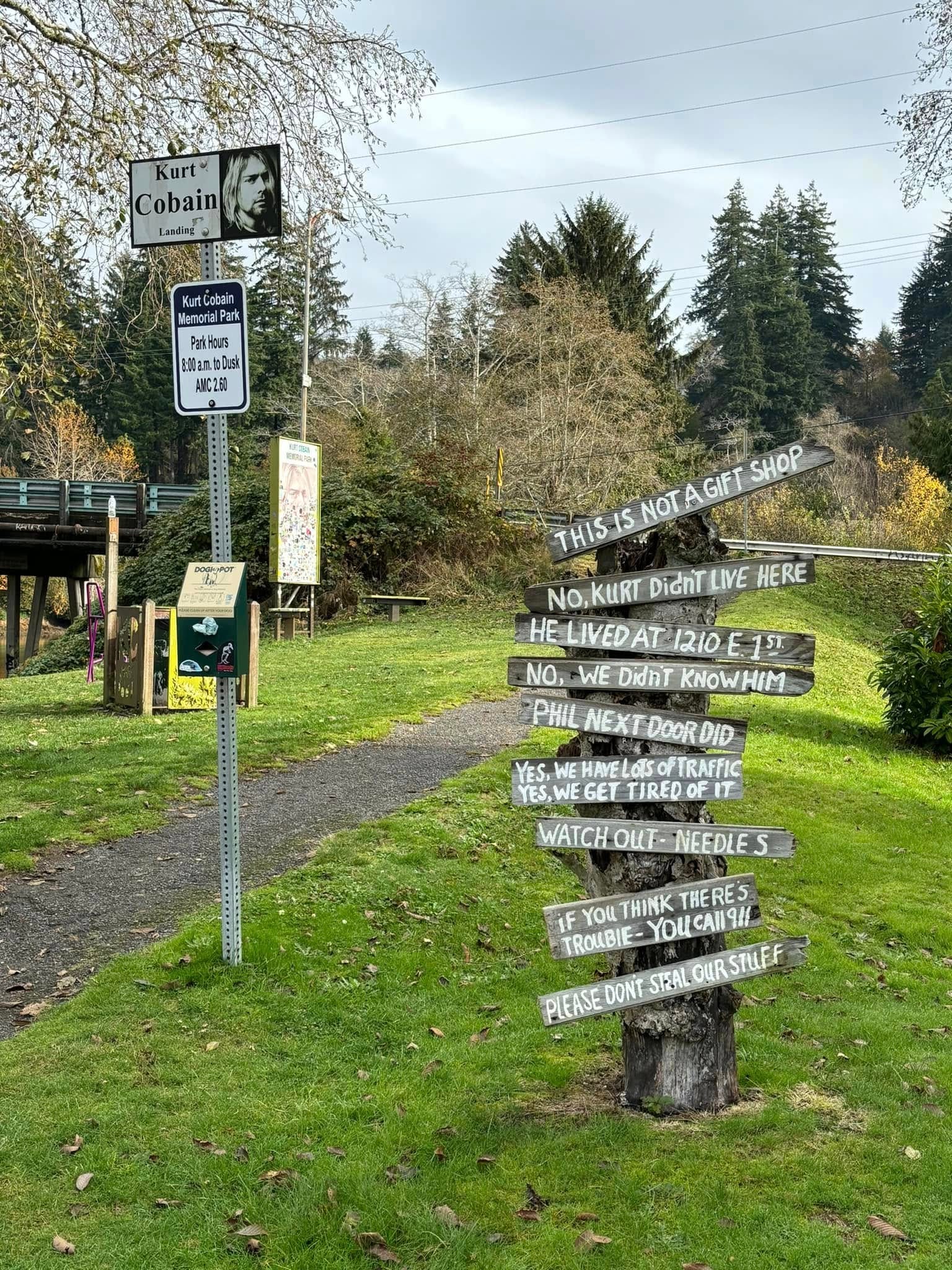
I also love the folks who live here and nailed plywood signs to a tree trunk.
In all capital letters from top to bottom, the signs say:
“THIS IS NOT A GIFT SHOP
NO, KURT DIDN’T LIVE HERE
HE LIVED AT 1210 E 1ST
NO, WE DIDN’T KNOW HIM
PHIL NEXT DOOR DID
YES, WE HAVE LOTS OF TRAFFIC
YES, WE GET TIRED OF IT
WATCH OUT – NEEDLES
IF YOU THINK THERE’S TROUBLE – YOU CALL 911
PLEASE DON’T STEAL OUR STUFF”
I laugh at the signs’ transparency and honesty – except the party about Phil. “Do you think that’s true? What a messed-up thing to do to your neighbor” I chuckle.
There is a man sitting on park bench that’s been spray-painted white and bolted to a cement block. He and the bench face the Wishkah River.
His backpack tells me he could be unhoused, but he could be here for the same reason: paying respect to the founder of Nirvana, who died by suicide in April 1994.
I tell Russell with my eyes that I’m going to give the stranger space and check out the bright graffiti painted under Young Street Bridge. I don’t see much writing dedicated to Kurt or Nirvana at all, and I know anything written or left by Kurt is long since covered over, but history tugs at me like the force of gravity.
I’m standing on the banks of the muddy Wishkah, just like the posthumously produced live Nirvana album of the same name. This is the same spot where Kurt Cobain spent time “underneath the bridge” like he sang in “Something in the Way.”
The riverbank is lined with broken trees that from a distance look like waves of grain but, close-up, are knives stabbing the water. Maybe even syringes.
The sight of discarded tote bags and the smell reminds me of times in my life when I gathered under bridges for nefarious purposes like illegal drug use. I know the plywood signs warning of needles, trouble and 911 isn’t a joke.
As I traipse around, I start feeling like a junkie looking for an out-of-the-way place to get high. This grunge mecca could be any muddy bridge underpass in any city anywhere, but the wet dirt here holds the misery that Kurt turned into music.
Though it doesn’t feel like we should be here, Russell and I crunch our way through fallen leaves. I set my laptop up on a square wooden table that’s bolted to a slab of concrete.
The man who was by the bench moved on, so Russell and I are the only people in sight.
Someone wrote “Road Trip 2024” on the top of the table, where the wood is chipped and unpainted. One of the bench seats wears a Kurt Cobain quote in silver Sharpie, “It’s better to burn out than fade away.”
I know this place isn’t always this quiet, but I swear I can hear the air moving. I can feel melancholy hovering like thin fog.
Russell calls over, “Hey look! Kurt’s air guitar” and I walk over to see a sculpture of an empty guitar stand. Cute.
I write for about an hour, and, when my laptop battery has little left to give, Russell and I pack up and head for the car.
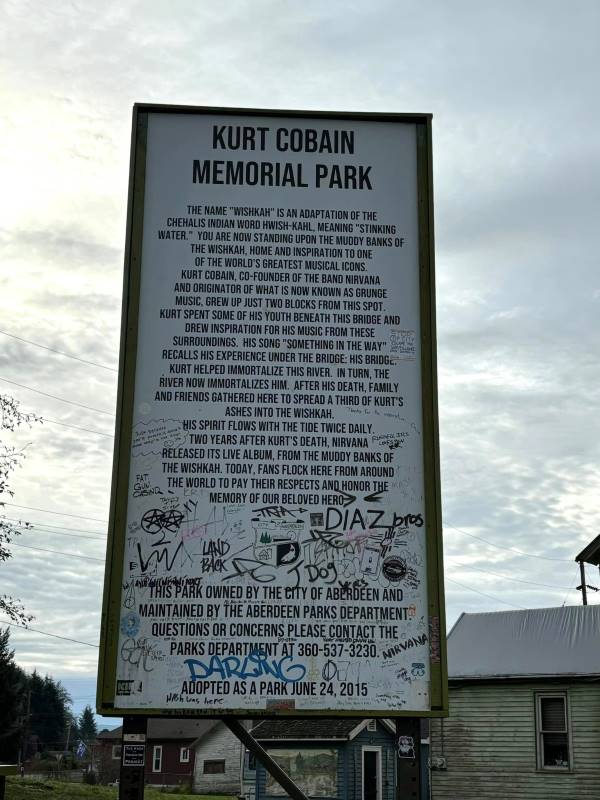
A large rectangle of words headlined KURT COBAIN MEMORIAL PARK faces us, so I open my cellphone camera to snap one last photo. I scan the history written on the official city parks department marker, but the bottom reads, “After his death, family and friends gathered here to spread a third of Kurt’s ashes into the Wishkah. His spirit flows with the tide twice daily.”
He’s here with us.
The legendary founder of grunge grew up relatively poor in the “lumber capitol of the world” during the 1970s and ‘80s. Kurt Cobain was a child of divorced parents and extreme emotion.
He left Aberdeen in 1984 and died about 100 miles away a decade later.
I finally made it to Kurt’s childhood neighborhood in November 2024, forty years after Kurt Cobain left to make his fortune and be named the “voice of a generation.”
My Pilgrimage couldn’t have been better timed. I earned a fellowship to attend a conference in Seattle – all expenses plus a stipend paid – so my husband and I booked an Air B&B for a few days before checking in at the hotel hosting the Gerontological Society of America’s annual gathering.
We landed in Seattle and rented a sedan. We listened to nothing but Nirvana from that moment.
We didn’t have time to do both, but I knew as soon as I tasted the city’s air that I had no desire to go anywhere near the last place Kurt lived in Seattle. The rainy fall breeze warned of an energy surrounding that place.
I wanted to see Aberdeen and better understand what shaped the person he became.
Our bodies took up space in the same place decades apart.
I needed enough time to breathe in the air and absorb the moment, but we had 24 hours to return the rental car.
Russell and I barely had time to grab lunch on the way back to Seattle’s airport.
The city of roughly 17,000 people sits on Washington’s coast about two hours from Seattle.
The Cascade and Olympic mountains protect the metropolitan area from harsh weather like hurricanes or the tornadoes they shake off. The air is calmed by the terrain and arrives over land as moisture threatening rain.
A higher percentage of people living in the Seattle area experience seasonal affective disorder or feel “blue” during rainy, low light weather.
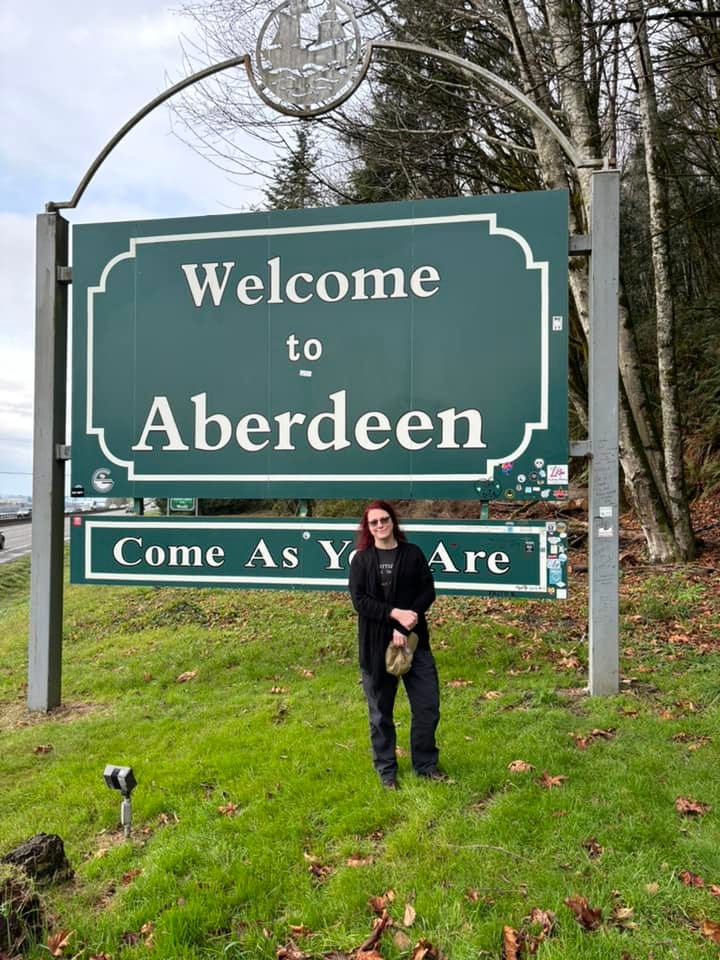
We weren’t the only car that pulled over to snap a selfie of the “Welcome to Aberdeen: Come As You Are” sign that day.
As we climbed up the soggy green hill toward the sticker-covered marker, we waved at the couple returning to their car. We asked if they planned to visit the Kurt Cobain Memorial Park, but I don’t think they had heard of it.
“TANYA 2024” was written in black Sharpie above a fatter lined “FAITH K” upon the green highway marker. It looked like the graffiti was painted over often.
A few feet beyond the welcome sign, another marker welcomed visitors to the “lumber capitol of the world.”
Far fewer selfies are taken in front of that sign. But that’s where Kurt grew up.
He spent his formative years falling in love with punk rock in a modest house on East First Street in Aberdeen, three miles from the bank of the Wishkah River. The privately owned property allegedly still houses his mattress and other signs of Kurt’s childhood.
The unassuming American neighborhood hadn’t changed since Kurt left.
I still smile when reminded that the inspiration for the famous song, “Smells Like Teen Spirit” came from graffiti written on a wall. “Teen spirit” referred to the deodorant of the same name.
This song breaking Nirvana into mainstream rock music so unique a new genre called “grunge” emerged as a label for Nirvana and other Seattle area bands.
Our so-called voice of a generation was screaming.
His messy, noisy, angry yet melodic music is simple to play but painful to process. His songs were an onslaught of emotion. I felt each chorus viscerally. I screamed along. Kurt Cobain is believed to have lived with bipolar disorder, symptoms of which were worsened by heroin misuse and fame.
When his high school-sketchbook-band, Nirvana, took off, teenage Kurt moved to Seattle, also known for its Space Needle, and paid $1.48 million in January 1994 for a Queen Anne-style mansion built in 1902. He meant this to be home with his wife and toddler daughter.
The demons got in, though, and destroyed him.
Kurt Cobain injected a potentially lethal dose of heroin and pulled the trigger of a shotgun under his chin. He killed himself in the greenhouse above a detached garage. Kurt’s body lay dead about three days before a maintenance person visited the property and noticed something through the window.
They found him on my little sister’s birthday, April 8, 1994. I was 15 and devastated.