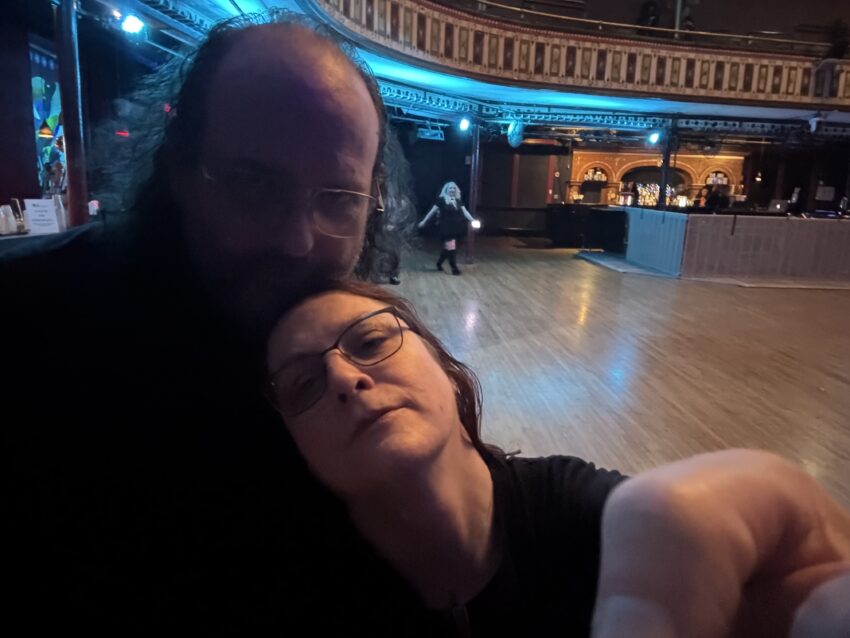
My husband and I drove to Atlanta in a time machine to see Marilyn Manson at the Tabernacle on May 20, 2025.
By that, I mean I went to recreate my experience of following the band’s first headlining tour for the band’s 1994 release Portrait of an American Family, when I was a teenager and cut school to arrive early enough to grab a spot on the front row barricade in the pit of general admission.
My best friend, Meredith, and I discovered Marilyn Manson when they started opening shows for Nine Inch Nails. Founder and frontman Trent Reznor took the band on tour after witnessing the earliest iteration, “Marilyn Manson and the Spooky kids,” from Fort Lauderdale, Florida.
The act was a concept and a commentary on society.
Band members adopted formulaic names that married models with murderers: Marilyn Monroe and Charles Manson produced Marilyn Manson.
The juxtaposition of good and evil.
Twiggy and Richard Ramirez (the “Nightstalker”) created the bass guitar player Twiggy Ramirez, who wore baby doll dresses and wigs. He played with his toes pointed inward, swaying so his locks buried his long, makeup smeared face.
Daisy Duke and David Berkowitz (the “Son of Sam”) turned into guitarist Daisy Berkowitz, who tied his green hair around his head like curtains.
Madonna Wayne Gacy wore a pointed goatee that looked like he dipped his facial hair in black paint. Band members referred to him by “Pogo,” which was the name of the clown played by serial killer John Wayne Gacy at children’s parties. Downstage and hidden, Pogo’s keyboards moved on their stands like marionettes.
Sara Lee (baked goods which “nobody doesn’t like”) and Henry Lee Lucas produced Sara Lee Lucas, the drummer until March 1995, when Manson set his kit on fire during a show. Lucas was replaced by Ginger Fish, whose name came from Ginger Rogers and Albert Fish.
Later band members adopted the names Olivia Newton Bundy and Gidget Gein.
Frontman and founder Marilyn Manson, whose legal name is Brian Warner, appeared on television talk shows such as Phil Donahue, and championed philosophical thinking and the questioning of organized religion. I started reading true crime, wearing all black and painting my face to shock anyone who saw me. I hid in plain sight, knowing I wasn’t being rejected because of who I was. It was the weirdo I portrayed.
I knew why kids were staring at me when I smeared a black ring around my eye with lipstick.
My 15-year-old partner-in-crime, Meredith, and I started a fanzine called “The Family,” as a nod to the Charles Manson cult members as well as fans of Marilyn Manson. We wrote articles about the serial killers that the band members drew names from, and we analyzed the various samples in Marilyn Manson songs to locate their origins.
We sold photocopied issues at school.
Meredith and I snuck out Wednesday December 7, 1994, taking the PATH train from New Jersey into New York City to see Marilyn Manson open for Nine Inch Nails, but guitarist Robin Finck sustained some kind of injury to his finger.
Moments after meeting NIN touring keyboardist James Woolley in the crowd, Mr. Manson and Twiggy appeared on stage to announce the show would be postponed to the following school night.
Trying to get back home on that night, police in Grand Central Station detained me and my friend because we matched the description of two “runaways,” they said. As we sat in the mini police station within the station, we worried what our parents would say if the cops were to call them.
I stole a 20-sided die from the officer’s desk and convinced Meredith to run out with me. We weren’t “under arrest,” I said as I promised not to leave her behind.
We got away and made it back the following school night to catch the show.
A static crescendo of buzzing and buried voices filled the room before Marilyn Manson took the stage against a backdrop of a Ouija board. Giant lamps and dolls wearing dildos decorated the stage as glowing green spotlights lit the singer through pervasive white fog.
Messages like “kill God” and “hate” appeared on Lite Brite toys.
The self-proclaimed god of fuck hunched over the stage monitors like he was sizing up the audience,
This tall, lanky kid with long black hair expelled lyrics from his lungs like an alien bursting out of someone’s chest. Bare chested and in tight leather pants, he slammed the microphone stand against his body in time with cymbal crashes on “Lunchbox.”
Lyrics like “next motherfucker gonna get my metal” taught me about banning metal lunchboxes because they could be used as weapons.
“In the 1970s, a group of outraged, disgruntled, Floridian mothers lobbied against the metal boxes, saying children were swinging them at peers and wreaking havoc on their gentle skulls,” according to an article in Atlas Obscura, which said many other states soon followed and popular lunch box companies were forced to switch to vinyl products.”
Plastic was also cheaper and became virtually ubiquitous by the late 1990s.
I carried a metal lunchbox – I think it was He-Man – to high school because I loved the idea of fighting back against bullies with a handheld statement of identity. The sandwich and juice box inside only added to my would-be weapon’s discrete utility.
I wanted to “grow up and be a rock star so no one could fuck with me,” and I sang along with the honest agony in Manson’s voice during those early shows. He whipped himself with his hair as he headbanged and thrashed around releasing a negative yet empowering energy.
Manson held a flashlight under his chin as he sang a cover of “Sweet Dreams (are made of these)” by the Eurythmics. He moved the light arm’s length in front of his face when he sang, “Some of them want to use you” and under his chin for, “Some of them want to be used by you.”
The buildup peaked when he smashed the light against his chest and cut himself with broken glass.
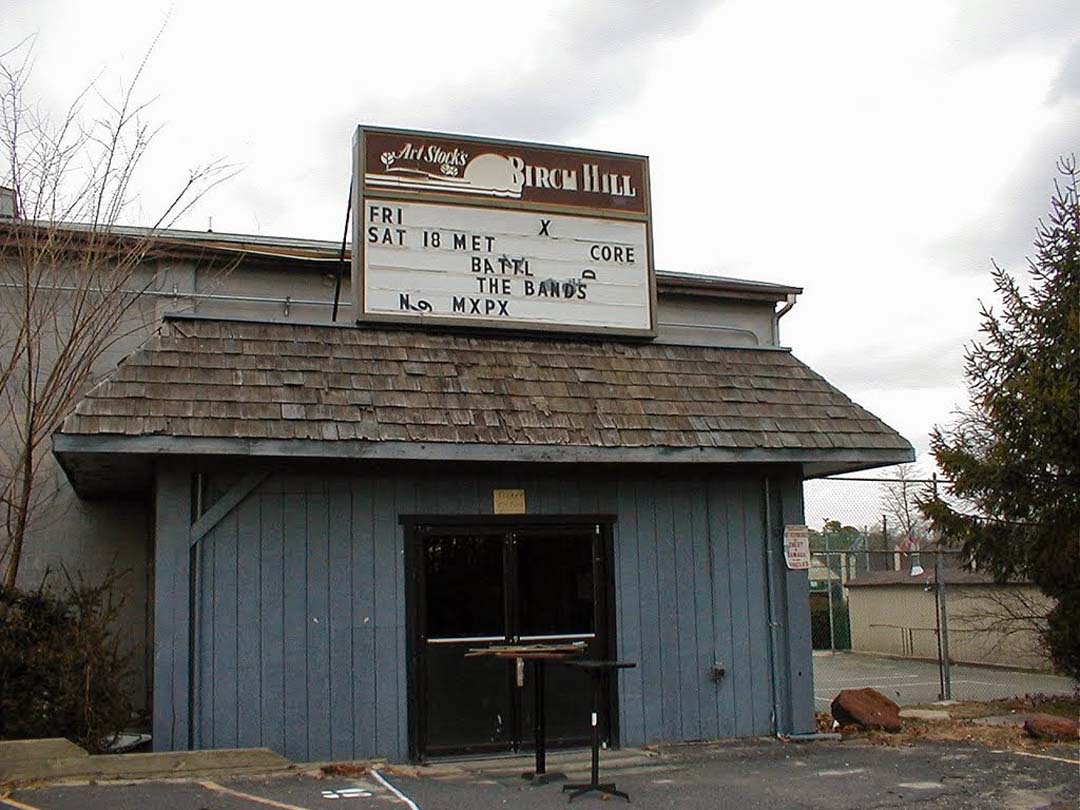
I caught four shows in three different states on the 1995/96 tour for Portrait of an American Family, including a show at the Birch Hill Nite Club in Oldbridge, New Jersey, which closed in 2003 after succumbing to the obvious evils of the surrounding neighborhood. It was the kind of dive where you’d expect a crowd stampede or a stabbing.
I stood at the front of the line for shows at Irving Plaza and The Academy in New York City with a couple who carved “Marilyn” and “Manson” into their chests with razor blades. Protesters regularly showed up outside the music venues.
My minivan full of friends crossed the state line into Pennsylvania for a January 1996 show at Starz in Allentown.
That’s when we met the band outside a tour bus on a chilly afternoon. I painted a black ring around my eye and slashed red lipstick marks on my eyelids. We brought a double-headed dildo as a gift.
Twiggy accepted it, asking what he thought we expected him to do with this.
We smiled, coyly, and pointed to Manson. “Ask him,” we said.
I thought for a long time that I met the frontman on his 25th birthday, but I did the math: 1996 – 1969 = 27, of course.
I got the chance to wish Manson a happy birthday and shake his hand. When he stumbled over a speaker, instead of acting embarrassed when someone asked if he was OK, he said, totally deadpan, “I don’t feel pain.”
My boyfriend said Manson purposely squeezed his hand when they shook. I don’t remember the details, but at least four of us wound up in the lobby of the hotel where the band stayed. Meredith, my boyfriend and I waited while another friend went upstairs with Twiggy. The teenager later said she contracted a sexually transmitted disease that night.
Manson was accused of domestic and sexual abuse including accusations of “grooming” behavior by Manson in 2005, when he was 36 and dating an 18-year-old actress.
That actress named him as her abuser in early 2021, just as the coronavirus pandemic kept us caged.
Loma Vista Records immediately dropped Marilyn Manson and stopped promoting albums because of the allegations.
By the end of 2021, five women made alarming accusations concerning events from more than a decade ago. One of those women later recanted, saying she was bullied by other exes to spread publicly false allegations in lawsuits.
“My art and my life have long been magnets for controversy,” Manson wrote in response.
That’s what I always loved about the act.
The frontman lost himself somewhere in the thirty years since I’d first seen him perform, and I didn’t know if I should support his career.
In 2024, Marilyn Manson returned to touring and I thought about covering an Atlanta area show for a music outlet. In an act of #metoo era solidarity, the editor replied that he had no desire to run anything about the band, saying “[Manson’s] doing the Louis CK ‘pretending what he was accused is completely different from what he was actually accused of’ stuff.”
So, I skipped the September 2024 show despite hearing that the shock rocker cleaned up, lost weight and was performing like he did in the 1990s.
In January 2025, Manson settled all the abuse lawsuits without charges filed.
I drove to Atlanta in a time machine May 20, after hearing Marilyn Manson’s front man quit the drugs, lost the weight, and found his je ne sais quoi.
But what he regained from his youth didn’t include his band. The dichotomous characters no longer existed among guitarists Tyler Bates and Reba Meyers, drummer Gil Sharone and Matt Montgomery (a.k.a. Piggy D.) on bass.
The “spooky kids” were lost like orphans in state custody.
My husband and I arrived hours early, but the entrance line was already long. I sent him across the street for burgers and fries, thinking we would be waiting a while for doors to open. The security guards took pity on us despite realizing late that we were in the wrong line. After paying more money to stay in that line and sending my husband back to the car to store my burger, we got in with some of the first fans inside.
I ran to the front row and folded my lacy black sweater over the barricade just like I did 30 years ago with a heavier coat in a colder climate.
Instead of the sweaty, human-heated mosh pits of yore, the Tabernacle stayed cool even as the opening act ended its set. In the general admission floor section, big guys stood like boulders between warring women, but I could still feel the breeze of the air conditioning.
Manson hunched over a speaker mounted on the stage with his tiny legs laced in knee high back leather boots and opened the Atlanta show with “Nod if You Understand,” the third track on the November 2024 release, One Assassination Under God – Chapter 1.
I could see the scars across his arms when filtered green light lit Manson’s tattoos through white fog.
Fans trying to capture steady cellphone video of the moments they were missing replaced crowd surfers, so the event was much safer than back in the day, but we paid way too much money to watch the show through a screen. Especially if the device belonged to the person blocking my view.
So, I did my best despite my dry mouth to sing as loudly as I could directly at their phone-clutched hands. Because fuck them, really. And the whole show is on YouTube with better sound than what I heard live in person strained through earplugs.
Manson looked more like he was doing a cardio routine with choreographed arm movements and come-hither jazz fingers than pouring his heart into his art. Trading drug enhanced existential anger for aerobic activity is best for the 56-year-old man.
It was a great show, but I will never be the same.